
Discover top trends shaping digital marketing

How Generative AI Is Transforming Content Marketing Workflows
October 29, 2025
Discover top trends shaping digital marketing
Introduction
Digital marketing evolves fast. What worked last year may already be stale. In 2025, marketers must stay agile, blending data, creativity, and ethics to stay ahead. Below are the most important trends to watch — and how to apply them.
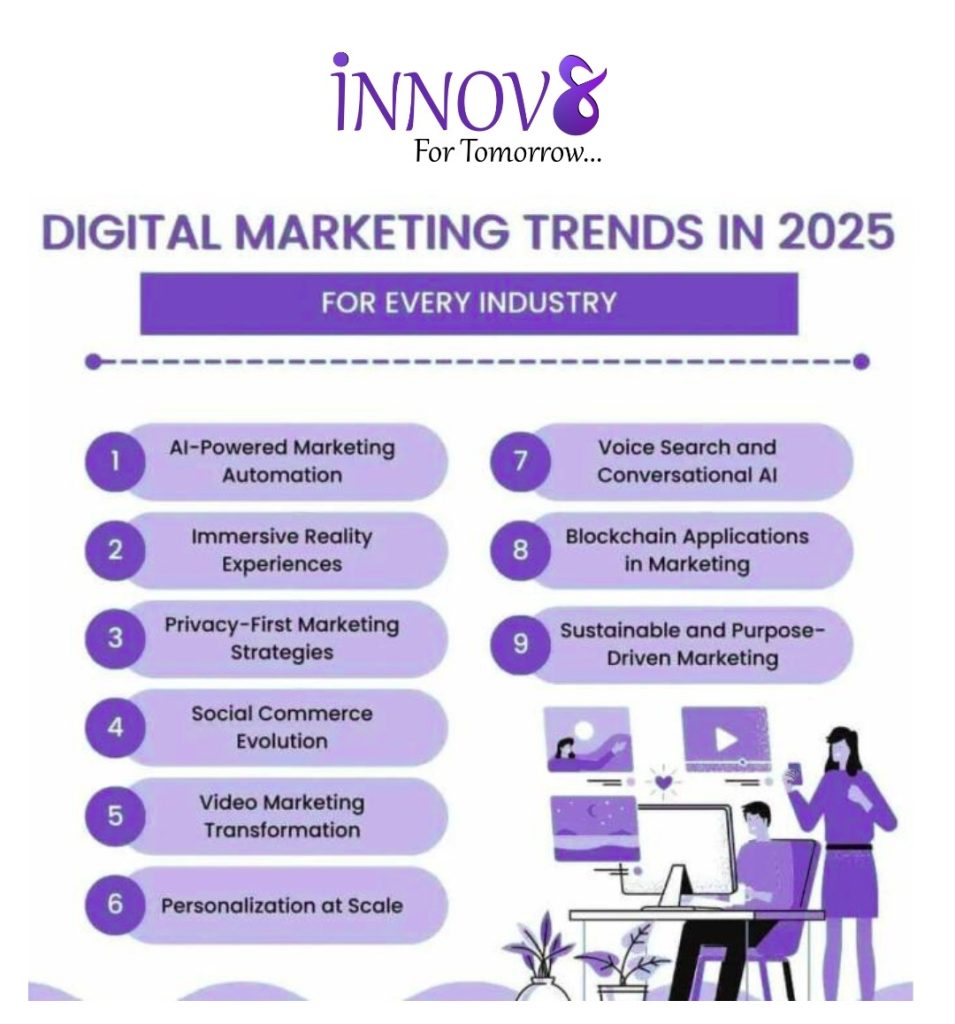
1. Generative AI & Content at Scale
- Generative AI (e.g. GPT‐style models) is transforming how marketers ideate, draft, and personalize content.
- Many marketers already use AI to write copy, generate visuals, and support brainstorming.
- But quality control, brand voice consistency, and “human-in-the-loop” review remain essential.
How to apply: Use AI to assist drafting (emails, blog outlines, social posts), then have human editors refine and add brand tone.
2. Search “Everywhere” & AI-Driven Answers
- Traditional SEO is bumping into new formats: voice search, visual search, AI chat assistants, and “answer engine optimization” (AEO) are gaining traction.
- For example, queries answered by AI hubs or chatbots may reduce click-throughs to websites.
- Marketers need to optimize not just for keywords, but for context, structured data, and snippet-worthy content.
How to apply:
- Use FAQ / question-answer formats
- Include schema markup, structured data
- Craft content that’s likely to be cited or excerpted
- Optimize for voice-style queries (“how do I…?”, “what are the best…?”)
3. Hyper-Personalization & Predictive Analytics
- Consumers expect experiences tailored to their preferences, behavior, and context.
- Predictive models help anticipate what content or products a user might want next.
- Real-time decisioning: deciding ad bid, creative variant, or content flow based on live user data.
How to apply: Set up user segmentation, test dynamic content, and feed behavioral data back into your campaigns.
4. Short-Form Video, Live & Interactive Content
- Short-form video (TikTok, Instagram Reels, YouTube Shorts) continues to dominate engagement.
- Live streams, interactive polls, Q&A sessions boost authenticity and engagement.
- Convertibility: shoppable video formats that allow users to click or buy directly.
How to apply:
- Produce 15–60 sec vertical videos
- Host live sessions with your audience
- Use “in-video” clickables or overlays for product info or links
5. Social Commerce & Platform Convergence
- Social media platforms become shopping destinations (not just discovery).
- Brands blend content + commerce via “shop now” features, live selling, in-app checkouts.
- Platform convergence: blurring of roles among search, social, e-commerce, messaging.
How to apply:
- Enable shop features on social profiles
- Tag products in posts / reels
- Use unified attribution across platforms to measure performance
6. Voice, Visual & AR/VR Search
- Voice assistants and voice search are expanding, so conversational keywords are key.
- Visual search (users upload an image to find similar items) becomes more accurate and widespread.
- AR / VR experiences let users “try on” virtually or immerse in branded environments.
How to apply:
- Add descriptive alt text, image tags
- Use 3D/AR assets for products
- Create AR try-on filters on social platforms
7. Ethical & Privacy-First Marketing
- Privacy regulations (e.g. GDPR, CCPA) and user expectations push marketers to adopt first-party data strategies and transparent policies.
- Value-based branding: Consumers prefer brands aligned to social causes, sustainability, and authenticity.
- Avoiding dark patterns, ensuring consent, and being transparent in data usage is more important than ever.
How to apply:
- Use clean data collection (opt-ins, clear privacy policy)
- Communicate how you use user data
- Show brand values through storytelling and action
8. Smarter Automation & Marketing Ops
- Automation tools will evolve: not just scheduling posts, but triggering workflows, adapting creatives, optimizing budget allocations dynamically.
- Marketing operations (martech stack, processes, integrations) become critical to scale efficiently.
- Standard Operating Procedures (SOPs) for marketing workflows reduce reinventing the wheel.
How to apply: Build modular workflows (e.g. lead nurturing, retargeting), integrate analytics and campaign tools, document repeatable steps.
9. Disintermediation & Direct Customer Relationships
- Brands are trying to bypass middlemen (e.g. retailers or publishers) to connect directly with customers.
- Zero-click results (AI/answer overviews) reduce clicks to websites, so you need to be embedded in those overviews.
- Conversational marketing (chatbots, messaging) can foster direct relationships.
How to apply:
- Embed brand presence in AI answer snippets
- Build conversational bots or in-app messaging
- Encourage subscriptions, communities, direct channels (email, apps)
10. Micro / Nano Influencers & Community Marketing
- Mega-influencers still exist, but niche, micro and nano influencers can yield stronger trust and engagement in specific segments.
- Community-driven content (forums, in-group chats, branded communities) becomes more valuable than mass broadcasts.
How to apply:
- Partner with relevant micro influencers
- Encourage user-generated content (UGC)
- Cultivate brand communities via platforms (Discord, Slack, Facebook Groups)
Strategic Tips for Adopting Trends
- Start small, test fast
Don’t try to adopt all trends at once. Pilot one or two in a low-risk campaign. - Align with your business goals & audience
Choose trends that resonate with your target audience’s behavior. - Measure and iterate
Use analytics to see what moves the needle, then double down where you see traction. - Keep human oversight
Even with automation and AI, human review is needed to preserve brand voice, ethics, nuance. - Stay informed and flexible
Trends evolve. Continuously monitor updates, case studies, failures and successes.
Frequently Asked Questions (FAQ)
Q1. Which trend is the most “must-do” in 2025?
While priorities differ by business, generative AI + search optimization (for AI/answer engines) and hyper-personalization are foundational for most companies.
Q2. Will AI replace human marketers?
No — AI is a tool. Humans bring context, creativity, strategy, and values. AI helps scale, accelerate and optimize.
Q3. How much budget should go into these new trends vs. existing channels?
Allocate a portion (say 10–30%) of your marketing budget to experimentation in new trends, while maintaining baseline investment in proven channels.
Q4. How do small businesses compete in a trend-driven world?
Focus on niches, use cost-effective tools, adopt trends selectively (not all), partner with local micro-influencers, and emphasize authenticity and value.
Q5. How often should I revisit or update my strategy?
At least quarterly — trends and platform algorithms shift fast. Regular reviews help you pivot early.


2 Comments
Test 123
Test